TS CEN/TS 54-14 & NFPA COMPLIANT

Fire Detection Systems Periodic Maintenance & Inspection

Full compliance with Fire Protection Regulations and Occupational Health & Safety standards; offering certified engineering inspections, periodic testing, detector calibration, chamber cleaning, and legally certified inspection reporting.

LEGAL & TECHNICAL OBLIGATION

Why Is Periodic Maintenance & Inspection Essential?

Fire alarm systems are life-safety infrastructures that must operate flawlessly 24/7. Statutory safety codes mandate regular testing and documented certification by licensed engineering entities.

📜

Fire Protection By-Law Compliance

Mandatory periodic testing and maintenance logs are legally enforceable. Failure to produce valid records during municipal fire inspections leads to steep penalties or shutdown orders.

⚖️

Occupational Health & Safety (OHS)

Workplace safety regulations mandate annual comprehensive inspection of all fire electrical systems by accredited engineers, documented with certified official testing reports.

🔕

False Alarm Elimination

Dust, industrial fumes, and insects contaminate optical chambers, triggering false alarms that disrupt production, cause panic, and incur expensive municipal dispatch fees.

🏢

Insurance Policy Validity

Insurance underwriters require up-to-date periodic maintenance logs and inspection certificates to honor claims after a fire incident. Unmaintained systems risk claim repudiation.

TS CEN/TS 54-14 STANDARD

Periodic Maintenance & Inspection Schedule

European and international standards prescribe four distinct maintenance tiers. ENELMED engineers execute monthly, quarterly, and annual procedures with utmost rigor.

Daily Checks

By Facility Staff

Visual verification of normal status by the building safety supervisor.

  • ✓ Verify normal healthy indicator (green LED) on the panel
  • ✓ Confirm absence of fault or isolation indicators
  • ✓ Log previous day events into the system logbook

Monthly Checks

Routine Service

Functional verification of alarm triggering and backup power continuity.

  • ✓ Trigger at least one detector or manual call point
  • ✓ Sounder and beacon acoustic/visual verification
  • ✓ Mains power cut simulation to test automatic battery takeover
  • ✓ Fault buzzer and indicator activation check

Quarterly (3-Month) Service

Technical Audit

Detailed zone-by-zone technical audit and structural coverage inspection.

  • ✓ Full analysis of internal event logs and historical faults
  • ✓ Zone/Loop response timing and signaling verification
  • ✓ Audit of new partitions or shelving obstructing detector coverage
  • ✓ Air-handler shutdown and voice evacuation relay testing

Annual Comprehensive Inspection

Certified Report

100% device testing, chamber cleaning, and certified legal report delivery.

  • ✓ 100% aerosol/heat testing of ALL field detectors
  • ✓ Optical chamber cleaning, ultrasonic clearing & recalibration
  • ✓ Battery load capacity, internal resistance & lifecycle testing
  • ✓ End-to-end building automation & fire scenario simulation
  • ✓ Official Engineer-Stamped Inspection Report
ENGINEERING METHODOLOGY

Our Professional Field Testing & Calibration Steps

Using calibrated test apparatus, aerosol dispensers, and digital diagnostic analyzers, our technicians guarantee zero-downtime inspection and peak system integrity.
Fire Smoke Detector Inspection and Testing
Aerosol & Heat Simulation

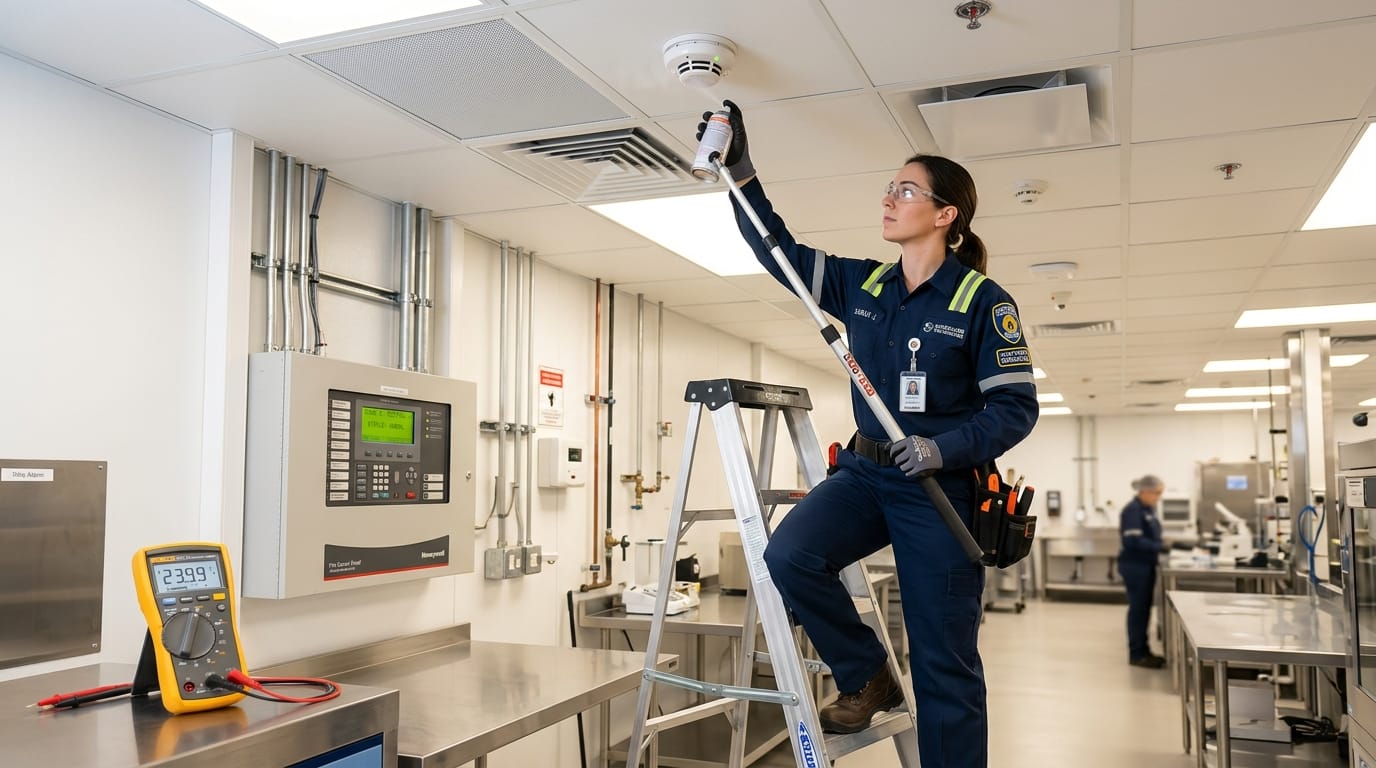
100% In-Situ Detector Testing with Telescopic Poles

From high-ceiling warehouses to cleanrooms, every smoke, heat, and multi-sensor detector is tested in-place using residue-free synthetic smoke aerosols. Response times and address mappings are logged to millisecond precision.
  • ✓ Certified testing gas leaving zero oily residue in optical chambers
  • ✓ Telescopic extension poles reaching up to 9 meters without scaffolding
  • ✓ Optical beam alignment and calibrated filter threshold verification
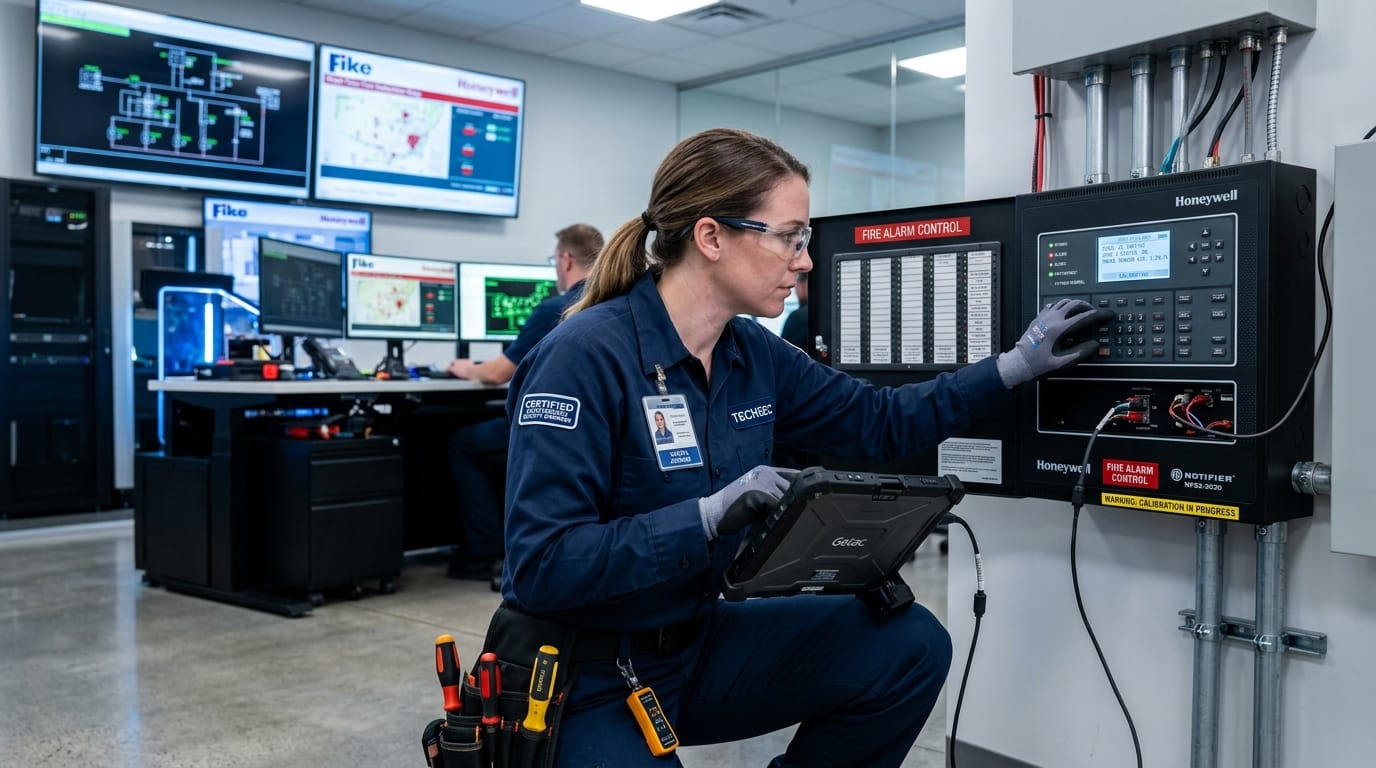
Fire Alarm Control Panel Calibration and Diagnostics
Digital Diagnostics

Control Panel Calibration & Battery Load Testing

Control motherboards, loop driver cards, and secondary battery arrays are subjected to rigorous diagnostics. We simulate power loss to verify that backup batteries can sustain standby for 24-72 hours followed by 30 minutes of continuous alarm evacuation.

  • ✓ Internal resistance and conductive load discharge analysis of batteries
  • ✓ Loop insulation resistance and short-circuit isolator validation
  • ✓ Firmware diagnostics, configuration backup, and historical event analysis
UNIVERSAL COVERAGE

Fire Systems Serviced Across All Brands

Independent of brand or vintage, our certified technicians service all types of commercial and industrial fire detection installations adhering to international standards.

🎯

Addressable Fire Systems

Loop-based pinpoint detection, contamination tracking, and protocol recalibration.

🏢

Conventional Fire Systems

Zone-by-zone end-of-line resistance testing, short-circuit, and line break simulations.

🔦

Optical Beam Smoke Detectors

Laser alignment, prism cleaning, and optical density testing in high-bay structures.

💨

Aspirating Smoke Systems (VESDA)

Airflow calibration, pipe integrity tests, and filter replacements in data centers.

🔥

Flame & Spark Detectors (UV/IR)

Optical lens cleaning, wavelength sensitivity testing, and explosion-proof integrity.

⚠️

Gas & Carbon Monoxide Systems

Calibrated gas testing in parking garages and boiler rooms for ppm response thresholds.

LEGALLY ACCREDITED

Certified Fire System Periodic Inspection Report

Issued upon completion of annual testing, our engineering inspection reports are legally binding and fully accepted by Municipal Fire Departments, Labor Ministries, and Insurance Underwriters.

✓ Device Inventory List Full address mapping of every tested detector, call point, siren, and I/O module.
✓ Empirical Test Data Battery voltage, internal resistance, loop impedance, and trigger response times.
✓ Corrective Action Plan Identified structural obstructions, aging hardware, and mitigation recommendations.
✓ Professional Engineering Seal Signed and stamped by certified electrical & electronics engineers with registration numbers.
FAQ

Frequently Asked Questions

Key answers regarding compliance, procedures, and advantages of periodic fire alarm servicing.

Is periodic fire alarm maintenance legally mandatory?
Yes, without exception. Workplace health and safety codes and fire safety regulations mandate that fire detection systems be inspected and certified at least once a year by licensed engineering professionals.
How often should maintenance and inspections occur?
According to TS CEN/TS 54-14, maintenance tiers are divided into daily visual checks, monthly functional trials, quarterly comprehensive servicing, and a mandatory annual 100% device audit resulting in an official report.
Will testing interrupt facility production or daily operations?
No. We coordinate testing around your facility's operational schedule. Control panels are switched to test mode, and automatic gas release and audible sounders are isolated during line checks to ensure zero disruption.
How does periodic servicing prevent false alarms?
Optical sensors accumulate airborne dust, humidity, and micro-particles over time, which scatters light and triggers false alarms. Regular servicing cleans the optical chambers and recalibrates detection thresholds.
24/7 TECHNICAL SUPPORT

Ensure Your Facility's Total Fire Readiness

Avoid regulatory fines and safeguard lives and assets with certified inspection contracts. Request a free on-site survey and maintenance quotation today.

Get a Free Quote → 📞 +90 224 504 60 00